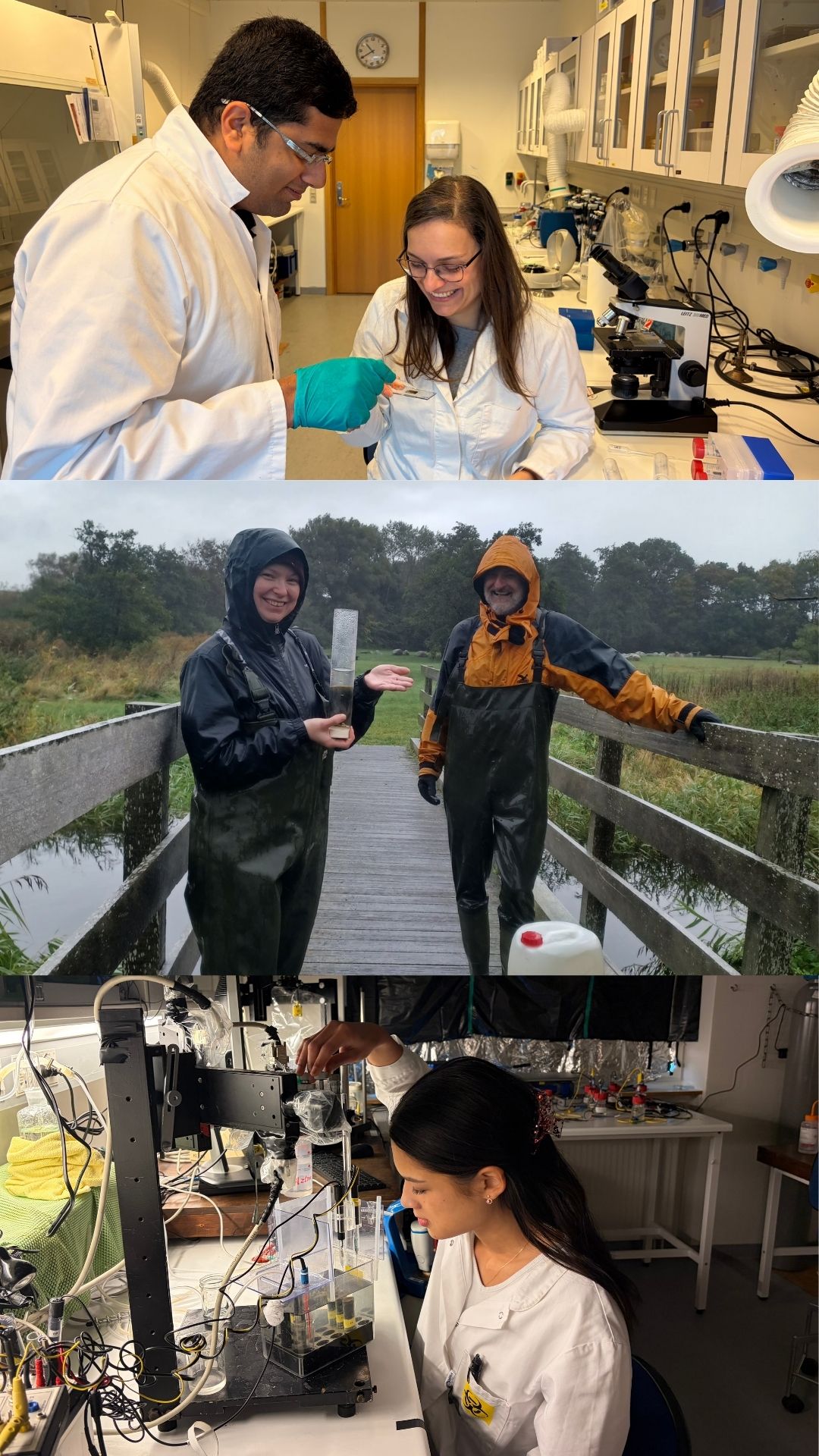
If you are interested in pursuing a project within electromicrobiology and cable bacteria, please contact the supervisor whose email address is listed below the relevant project description. If you have your own ideas about electromicrobiology that you would like to pursue with us, or if the projects below doesn't speak to you (although the research area does), we would still love to hear from you! Please contact a member of the core group to discuss additional projects.
All projects can be scaled to become biological projects, bachelor's projects, or masters' projects depending on what stage you are at.
We also welcome external students from universities other than Aarhus University who are interested in carrying out these projects as internships or thesis projects, although we regret that we cannot fund travel or living expenses for such short-term stays.
Cable bacteria can use both nitrate and oxygen, so what happens in sediment where nitrate penetrates deeper than oxygen? Are the electrons going to the energetically most rewarding acceptor, oxygen, or to nitrate that comes first for the electrons coming up through the bacterial wires from the deeper, sulfide oxidizing cells? Such questions challenge the conventional understanding of electron pathways in cells and environment and multiple hypotheses integrating enzymatic capacities, energetics, limiting factors, behavior, and electron conductor properties in cable bacteria could be imagined.
Supervisor: Lars Peter Nielsen
Methods: Tests can be conducted in sediment with rapid manipulations of oxygen and nitrate and simultaneous measures with electrical potential microsensors of rates and depths of electron harvest. Other approaches might be based on microscope observations of interface distortions by single cable bacteria.
Contact: Lars Peter Nielsen (lpn@bio.au.dk)
It is currently unknown what factors control cable bacteria population size. One hypothesis is that other microorganisms (either eukaryotes or prokaryotes) act as cable bacteria predators, and thus have an important role in cable bacteria population control. In this project, you will release cultures of potential cable bacteria predators into microcosms of cable bacteria, track their progress and determine the role they play in cable bacteria mortality.
Supervisors: Thomas Boesen and Andreas Schramm
Methods: FISH, qPCR, SEM, microsensors
Contact: Andreas Schramm (andreas.schramm@bio.au.dk)
Cable bacteria apparently have a fascinating physiology but many of their traits remain hypothetical predictions based on genome/transcriptome analyses. The goal of this project is to develop methods to generate cable bacteria mutants or reporter strains to verify predicted functions or localizations of certain proteins. This is a great challenge given that we cannot currently grow cable bacteria in pure culture (only as enrichment), that they have to be grown in a gradient system (they do not form colonies on plates), they are filamentous (multicellular!), and no genetic system is so far available. So the ideal student for this project is the adventurous type, ready for a "high risk - high gain" project!
Supervisors: Thomas Boesen, Andreas Schramm
Methods: molecular biology & microbiology, fluorescence microscopy (CRISPR-Cas9, GFP, knock-out mutants...)
Contact: Andreas Schramm (andreas.schramm@bio.au.dk)
While most studies of cable bacteria to date have focused on the candidate genera Electrothrix and Electronema, there are other, less-studied branches of the tree of life that also show evidence of long distance electron transport along a filament. The explosive growth of metagenomics means that many genomes from these clades have been sequenced and placed in public databases without being scrutinised for genes related to their potential cable bacteria activity. This project will take a closer look at these "bonus" genomes and determine critical similarities and differences with the cable bacteria genomes that have already been analysed. This is a good project for a student looking to improve their skills in genomics and bioinformatics, including programming.
Supervisor: Ian Marshall
Methods: Bioinformatics
Contact: Ian Marshall (ianpgm@bio.au.dk)
In this project, you will study how the transport of electrically charged molecules of environmental importance (e.g., nitrate, ammonium and phosphate) is altered by electric fields that develop naturally in lake and marine sediments and thereby contribute to expand our understanding on how nutrients are transported in aquatic the environments.
Supervisor: Ugo Marzocchi
Methods: Microsensors, geo(electro)chemistry, sediment sampling and incubations
Contact: Ugo Marzocchi (ugomar@bio.au.dk)
Ongoing trends of eutrophication and global change are increasing the intensity and frequency of anoxic events in aquatic environment menacing the survival of benthic organisms. This project will explore how electro-active organisms can help to enhance the ability of the benthic ecosystem to survive and recover from such environmental stressors.
Supervisor: Ugo Marzocchi
Methods: Sediment sampling and incubation, benthic fauna and flora characterization, quantification and viability tests, biogeochemistry.
Contact: Ugo Marzocchi (ugomar@bio.au.dk)