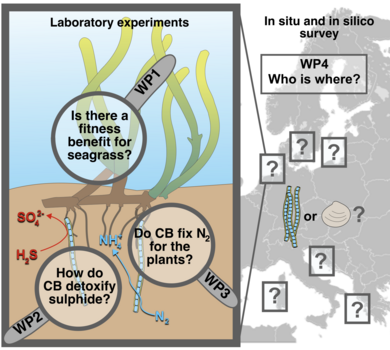
Seagrass meadows are crucial for maintaining healthy coastal environments, yet they are declining globally at an alarming rate. Traditional conservation efforts focus on reducing environmental stressors, but their limited success highlights the need for innovative approaches that do not look at the plants as single entities but acknowledge the role of key symbiotic interactions. One example is the symbiosis between seagrass, lucinid clams and their sulphur-oxidizing bacteria (SOB), which has been shown to enhance seagrass health by mitigating sulphide stress and increasing nutrient availability through nitrogen fixation. However, this symbiosis is absent in seas above 53°N, like Wadden and Baltic Seas. Cable bacteria (CB) are centimetre-long, filamentous bacteria, capable of long-distance electron transfer, coupling sulphide oxidation in anoxic sediments with oxygen reduction. These bacteria have recently been found in the seagrass rhizosphere, suggesting they could serve as an alternative symbiotic system, protecting seagrasses in northern regions. Despite reports linking CB presence with reduced sulphide levels, little is known about the mechanisms and potential benefits of this interaction for the plant.
Marie Skłodowska-Curie Actions (MSCA)
The Marie Skłodowska-Curie Actions fund excellent research and innovation and equip researchers at all stages of their career with new knowledge and skills, through mobility across borders and exposure to different sectors and disciplines. The MSCA help build Europe’s capacity for research and innovation by investing in the long-term careers of excellent researchers.The MSCA also fund the development of excellent doctoral and postdoctoral training programmes and collaborative research projects worldwide. By doing so, they achieve a structuring impact on higher education institutions, research centres and non-academic organisations. The MSCA promote excellence and set standards for high-quality researcher education and training in line with the European Charter for Researchers and the Code of Conduct for the recruitment of researchers.

