
Mystery solved: How Europe’s largest bat catches and eats passerines mid-air
After nearly 25 years of research, the mystery has finally been solved: Europe’s largest bat doesn’t just eat small birds – it hunts and captures them more than a kilometre above the ground. And it eats them without landing.


An international team of researchers has shed light on how Europe’s largest bat hunts and consumes small birds. The results, now published in Science, make for fascinating reading – a story of nocturnal aerial acrobatics, pursuit and predation.
Every year, billions of songbirds migrate between their breeding grounds and wintering areas. Many species fly high and travel at night, partly to avoid daytime predators. But that doesn’t make the journey risk-free – bats hunt at night.
Riding on bats' backs
Researchers have hitched a virtual ride on the back of Europe’s largest bat species – the greater noctule (Nyctalus lasiopterus) – by equipping them with tiny “backpacks” containing biologgers developed at Aarhus University. These instruments record the bats’ movements, acceleration, altitude, and sounds (including the bat’s echolocation calls), revealing their hunting techniques as they pursue prey more than one kilometre above the ground in total darkness.
The new study shows that these bats can fly high into the night sky to locate and attack unsuspecting birds. Unlike certain insects, birds cannot hear the bats’ echolocation calls and may only realise the danger at the very last moment, giving them little chance to escape.
The bats’ ability to detect birds at such distances is due to their loud and relatively low-frequency ultrasound echolocation calls. And once they are close enough to select their target, they attack – signalled by a rapid burst of short echolocation calls.
Daring dives
Data from the biologgers show that the bats pursued their prey in steep, breakneck-speed dives towards the ground, much like fighter aircrafts in dogfights.
They plunged vertically for 30 and 176 seconds respectively, beating their wings faster and harder and tripling their acceleration while emitting continuous attack calls.
The bat that dived for 30 seconds eventually gave up – birds are at least as agile in the air as bats.
Twenty-three minutes of chewing
The second bat, however, caught its prey close to the ground after nearly three minutes of pursuit. The microphone recorded 21 distress calls from the bird (a robin), followed by 23 minutes of chewing sounds from the bat as it flew at low altitude.
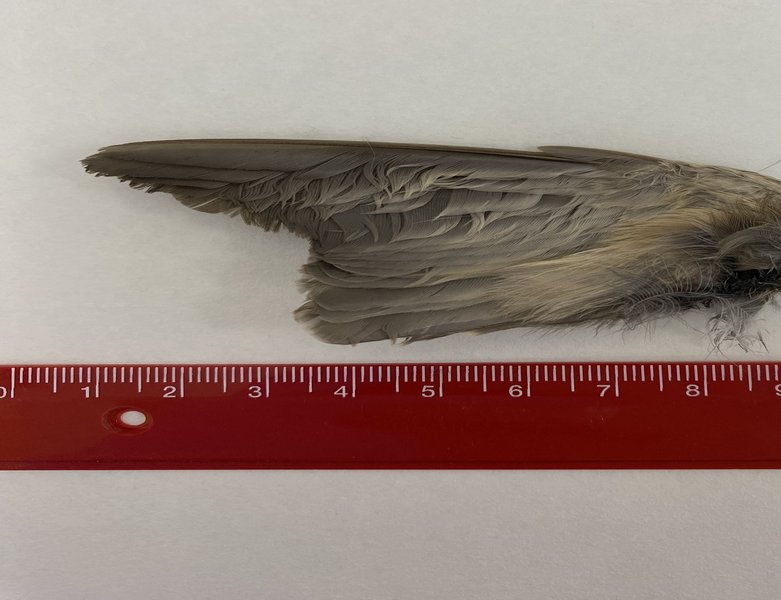
Combined with X-ray and DNA analyses of songbird wings found under the bats’ hunting grounds, the data from just two bats paint a clear picture of the final act:
The bats kill the birds by biting them, then bite off their wings – probably to reduce weight and drag. The researchers believe that the bats then stretch the membrane between their hind legs forward like a pouch and eat the bird mid-flight.
Wild manoeuvres
“We know that songbirds perform wild evasive manoeuvres such as loops and spirals to escape predators like hawks during the day – and they seem to use the same tactics against bats at night. It’s fascinating that bats are not only able to catch them, but also to kill and eat them while flying. A bird like that weighs about half as much as the bat itself – it would be like me catching and eating a 35-kilo animal while jogging,” says Assistant Professor Laura Stidsholt from the Department of Biology at Aarhus University.
She is one of the study’s lead authors and has for several years refined and applied biologger technology in her bat research, leading to numerous scientific papers – and surprises.
At the time when she finalized the data collection and did the analysis for this paper, Stidsholt was a Postdoc at the Leibniz Institute for Zoo and Wildlife Research (Leibniz-IZW) in Berlin.
A 25-year-old hypothesis
For a couple of decades, it has been known that at least three large bat species feed on small birds in flight. Much of this knowledge stems from the tireless work of Spanish bat researcher Carlos Ibáñez and his colleagues at the Doñana Biological Station (CSIC) in Seville.
Nearly 25 years ago, Ibáñez discovered feathers in the droppings of greater noctules and has since gathered mounting evidence that these bats catch and eat songbirds.
The Doñana research team has long studied the greater noctule, a rare and difficult-to-monitor forest species. They have installed “smart” artificial roosts in the Doñana Reserve and implanted each bat with a tiny subcutaneous microchip that is detected by an antenna in each roost. The system logs the bats’ movements, stores the data, and sends alerts directly to the team’s mobile phones.
Years of pursuit
For years, the researchers tried to uncover exactly how the bats managed to catch and eat birds in flight.
“We knew that the greater noctule catches and eats insects in flight, so we assumed it did the same with birds – but we needed to prove it,” says Carlos Ibáñez.
The hypothesis was initially met with scepticism within the scientific community, since some birds weigh up to half the weight of the bat itself and thus might reduce the bats’ ability to fly.
Because bats hunt at night, it is impossible to film the chase. Researchers instead tried surveillance cameras on roosts, military radar, ultrasound recorders attached to hot-air balloons, and GPS trackers. The main challenge was finding equipment light enough for the bats to carry.
Now, with the lightweight devices from Aarhus University – and just as Carlos Ibáñez approaches retirement – the team has finally caught a greater noctule in the act.
Essential for bat conservation
For Elena Tena, also a lead author of the study, hearing the sound recording of the bird’s distress calls followed by sudden silence and long chewing noises was an intense moment after so many years of effort:
“While it evokes empathy for the prey, it is part of nature. We knew we had documented something extraordinary. For the team, it confirmed what we had been seeking for so long. I had to listen to it several times to fully grasp what we had recorded.”
Fortunately, there is little cause for concern about bats threatening songbird populations. The greater noctule is extremely rare and, in many areas, endangered as its forest habitats disappear.
Thus, this discovery has important conservation implications. Understanding the greater noctule’s ecology and hunting behavior is essential for designing effective conservation and management strategies.
FACTS:
The greater noctule is the largest bat in Europe, with a total head and body length of up to 10.4 cm, a wingspan of up to 46 cm and a weight of between 35 and 60 grams. It lives in small and scattered populations in France, Spain, Portugal, southern Poland, the Caucasus, Iran, Kazakhstan, Gibraltar, Sicily and southern Greece. It is very rare everywhere, but it is most numerous in Spain and Greece.
Additional information | |
| We strive to ensure that all our articles live up to the Danish universities' principles for good research communication(scroll down to find the English version on the web-site). Because of this the article will be supplemented with the following information: | |
| Funding | VILLUM FONDEN, European Regional Development Fund (ERDF), the Spanish Ministry of Science and Innovation |
| Read more | The scientific article Greater noctule bats prey on and consume passerines in flight in Science |
| KontaktDEpartment of | Assistant Professor Laura Stidsholt Elena Tena Carlos Ibáñez |