As extreme climatic events are becoming more frequent, we need to understand what mechanisms could buffer populations to ensure their persistence. Fragmented populations may be especially vulnerable, as exemplified by species with metapopulation dynamics whose persistence is determined by a precarious balance between frequent local extinctions and recolonizations of interconnected habitat patches. We investigated whether variation in vegetation productivity between and within habitat patches can buffer metapopulation dynamics in years of drought. Using 24 years of long-term monitoring data from the Glanville fritillary butterfly Melitaea cinxia for over 4000 patches, we modelled butterfly patch occupancy and abundance dynamics as a function of vegetation productivity and its heterogeneity during the growing season, using yearly normalized difference vegetation indices (NDVI) estimated from satellite data. We then tested whether these vegetation heterogeneity effects differed between years depending on the magnitude of drought, measured as cumulative climatic water balance. Across years, butterfly occupancy was consistently highest in patches with low to intermediate vegetation productivity. However, for occupied patches, the effects of vegetation heterogeneity on butterfly abundances differed between years, showing opposite trends in dry versus wet years. In drier years, butterflies tended to be more abundant in patches of higher mean productivity, but this trend was not robust to estimate uncertainty. In contrast, in wet years and robust to estimate uncertainty, abundances tended to increase with higher levels of within-patch vegetation heterogeneity. These results indicate that patch occupancy and abundance dynamics could become decoupled, with chances of occupancy remaining unchanged despite variation in the conditions that promote local population growth during more extreme years. Nevertheless, our results suggest that vegetation heterogeneity can create enough variation in local population dynamics to support the metapopulation during extreme years. The type of vegetation heterogeneity needed for this support, however, varies with the type of climatic perturbation.
Read the all article here: https://nsojournals.onlinelibrary.wiley.com/doi/10.1002/ecog.08686
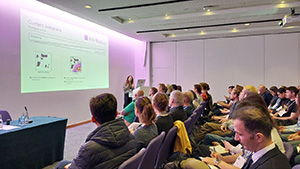
Charlotte Bunnenberg, PhD in our group, won the Anne Keymer Prize (best oral presentation by a postgraduate student) at the British Ecological Society Annual Meeting 2025, Europe’s largest conference dedicated to ecology. Read more about her prize and her talk, “Combining multi-layer network theory and individual-based modelling to analyse functional connectivity through time and space”, here: https://www.britishecologicalsociety.org/content/annual-meeting-prizes/
https://www.helsinki.fi/en/news/plants/are-agricultural-pesticides-environmental-threat
A University of Helsinki study demonstrated that pesticides can negatively affect non-target species living in agricultural environment. However, the effects varied greatly depending on the substance tested.
https://www.dr.dk/lyd/p1/vildt-naturligt/vildt-naturligt-2022-10-10
Edderkopper har vidt forskellige strategier for overlevelse. Derfor er deres udvikling oplagt at studere, hvis man vil forstå arters evolution. Hvorfor er nogle edderkopper sociale, mens andre er det stik modsatte? Hvorfor kan indavl nogle gange være en god idé, når det i andre tilfælde er den sikre undergang? Og giver edderkoppers ofte voldsomme parringsstrategier overhovedet mening? Professor Trine Bilde er ekspert i edderkopper, og hun prøver at overføre viden fra dem til generelle problemstillinger i en tid med truet biodiversitet.
Gæst: Trine Bilde, professor i evolutionsbiologi på Aarhus Universitet og centerleder for "Centre for Ecological Genetics" på Aarhus Universitet.
Værter: Johan Olsen & Vicky Knudsen. Producer: Carsten Nielsen.
