
Dense, dark forests in Europe are a modern phenomenon
For over 20 million years, the landscape of Europe has been a tree-rich mosaic of grasslands, scrubs and more or less open woodlands with an abundance of wildflowers. This is the conclusion of a new and comprehensive study of Europe’s vegetation history – a study that suggests modern afforestation runs counter to the continent’s long-term ecological trajectory.

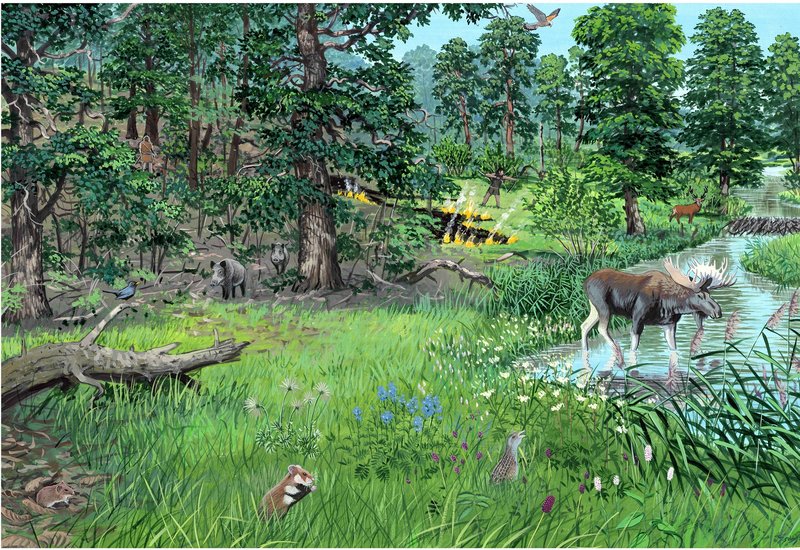
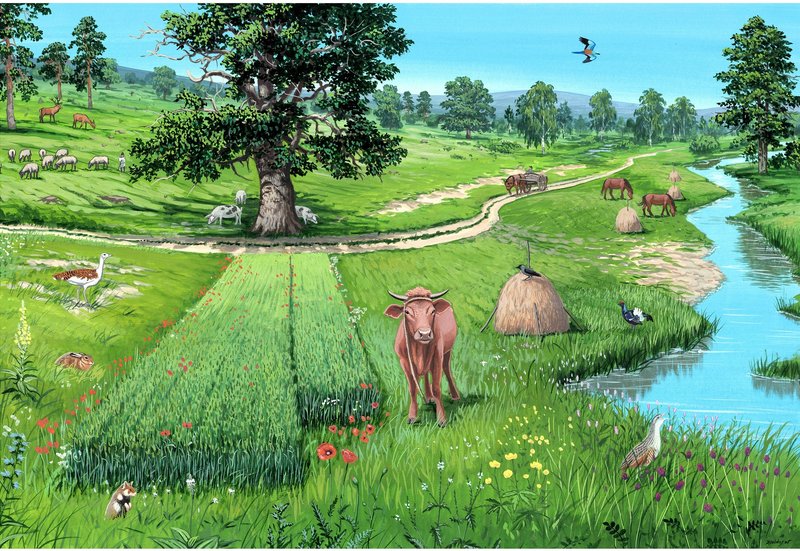
Imagine walking through pristine nature in central Europe 100,000 – or even a million – years ago. If you picture a dark, dense primeval forest, where sunlight barely reaches the forest floor, then you have taken a wrong turn. Not geographically, but temporally.
You simply have not travelled far enough back in time. Because that image resembles a modern production forest more than past reality.
But if you picture scattered woodlands combined with colorful flowery meadows, where lots of different birds and butterflies are thriving – you’re probably on the right track.
From nature’s perspective, the dense forests are a very recent phenomenon.
A new, comprehensive study led by Aarhus University shows that Europe’s landscapes over the past more than 20 million years have predominantly been a mosaic: a mixture of grasslands, scrub and woodlands of varying density. A light-filled, flower-rich open woodland shaped by grazing animals as a decisive ecological force – not a dark closed-canopy forest.
The study has just been published in Biological Conservation.
Reforestation at odds with nature
“The study shows that current reforestation practices are on the wrong track – both here in Denmark, where subsidies are only granted for planting dense forests, and elsewhere in Europe. This will not only be harmful for biodiversity; it will be in direct contradiction to the type of ecosystems that Europe’s species have evolved in over millions of years,” says Professor Jens-Christian Svenning from the Center for Ecological Dynamics in a Novel Biosphere (ECONOVO), Department of Biology at Aarhus University, senior author of the study.
Svenning adds, that the so-called “closed-forest paradigm” for decades has dominated nature management and our understanding of what is natural: the idea that dense forests with closed canopies were Europe’s natural baseline before human intervention.
All available palaeoecological evidence
The new study takes a significant step beyond previous research. Whereas earlier studies have primarily focused on relatively recent periods in the past, the researchers here bring together all available palaeoecological evidence covering the entire period from the Miocene epoch (which began around 23 million years ago) to the pre-industrial era.
The study is based on a large synthesis of independent lines of evidence. The researchers reviewed palaeoecological studies covering the last 23 million years and combined multiple scientific “proxies” that reveal past vegetation structure and ecological processes. These included pollen records, plant macrofossils, charcoal particles from ancient fires, stable-isotope analyses of herbivore teeth and bones, fossil insects and mammals, and ancient environmental DNA preserved in sediments.
“Each type of proxy offers its own perspective, but together they let us see whether the landscapes were covered by dense forests, open grasslands, or a mix of the two. By combining these datasets across time – from the Miocene to the pre-industrial era – we could trace long-term changes in vegetation and the role of large herbivores with much greater confidence than earlier studies that used only one method,” explains the study’s lead author, ECONOVO PhD student Szymon Czyzewski of Aarhus University.
The conclusion is clear: across this long period, the typical landscape was a dynamic tree- and flower-rich mosaic, where large wild herbivores such as elephants, rhinoceroses, aurochs and bison kept vegetation semi-open and diverse – and this was the case in temperate climates similar to those prevalent in Europe today, as well as in warmer and in cooler climates.
A continent without large wild herbivores
Another central conclusion is that present-day Europe is, in ecological terms, highly unusual.
“The ecosystems we see in Europe today lack the large wild herbivores that not only shaped landscapes but also sustained its biodiversity for millions of years. The most dramatic shift has largely taken place within the last hundred years, when traditional extensive grazing disappeared from large parts of the landscape,” says the Czyzewski.
The researchers also show that many species now regarded as characteristic of cultural landscapes – such as larks, jackdaws or the European hamster – are likely to have their evolutionary roots in the open woodland systems of the past. And the wild poppies, that we now mostly associate with fields, grew in herbivore-disturbed places within the ancient woodlands.
This suggests that the sharp division between “forest” and “open habitats” that characterises modern conservation practice is a modern invention.
Implications for reforestation and restoration
The findings have direct implications for nature management and biodiversity across temperate Europe – precisely at a time when forests are being planted in the name of climate mitigation and biodiversity.
If the goal is to restore ecosystems resembling those in which Europe’s species evolved and are still adapted to, the study indicates that uniform, dense forests are not the answer.
“Instead, restoration efforts should place greater emphasis on creating and maintaining mosaics of woodland and open habitats – not least through the restoration of natural-living large herbivores,” Svenning concludes.
The study thus reinforces growing evidence from earlier research from the same research environment: Europe’s past was lighter, more heterogeneous and more strongly shaped by large animals than we have long assumed.
One might say that the idea of the dark, dense primeval forest does not collapse overnight – but it loses yet another supporting trunk.
Additional information | |
We strive to ensure that all our articles live up to the Danish universities' principles for good research communication(scroll down to find the English version on the web-site). Because of this the article will be supplemented with the following information: | |
| Funding | VILLUM FONDEN, Danish National Research Foundation, Independent Research Fund Denmark |
| Collaborators | Welmud Out, Leiden University, The Netherlands. Bartosz Halik, Jagiellonian University, Poland |
| Read more | The scientific article in Biological Conservation |
| Contact | Szymon Czyzewski Jens-Christian Svenning |